AI Is Eating the World. But Today's Compute Cannot Feed What Comes Next.
Artificial intelligence is driving extraordinary demand for computation. But the systems powering that growth are colliding with increasingly consequential constraints in power, heat, latency, data movement, infrastructure, and economics.
Feeding what comes next will take more than adding more conventional compute. It will take fundamentally better ways to compute.
For decades, the computing industry created extraordinary advances by packing more capability into increasingly powerful systems. That approach changed the world. But today's most demanding workloads are exposing a growing set of connected constraints.
Power
More computation requires more energy. Data center power demand is projected to increase 165% by 2030.
Heat
More power creates greater cooling and infrastructure demands that limit where and how compute can be deployed.
Data Movement
Moving information between memory and processors consumes time and energy at growing cost.
Latency
For some applications, the value of an answer declines while the system is still processing it.
Infrastructure
Power, cooling, networking, real estate, and capital increasingly determine where compute can be deployed.
Economics
Adding more conventional compute can become an increasingly expensive way to create more useful intelligence.
More compute alone cannot be the only answer.
What If We Change the Way Computation Happens?
Zentient begins with a different question: What architecture would we design if speed, power, data movement, and infrastructure were fundamental constraints from the beginning?
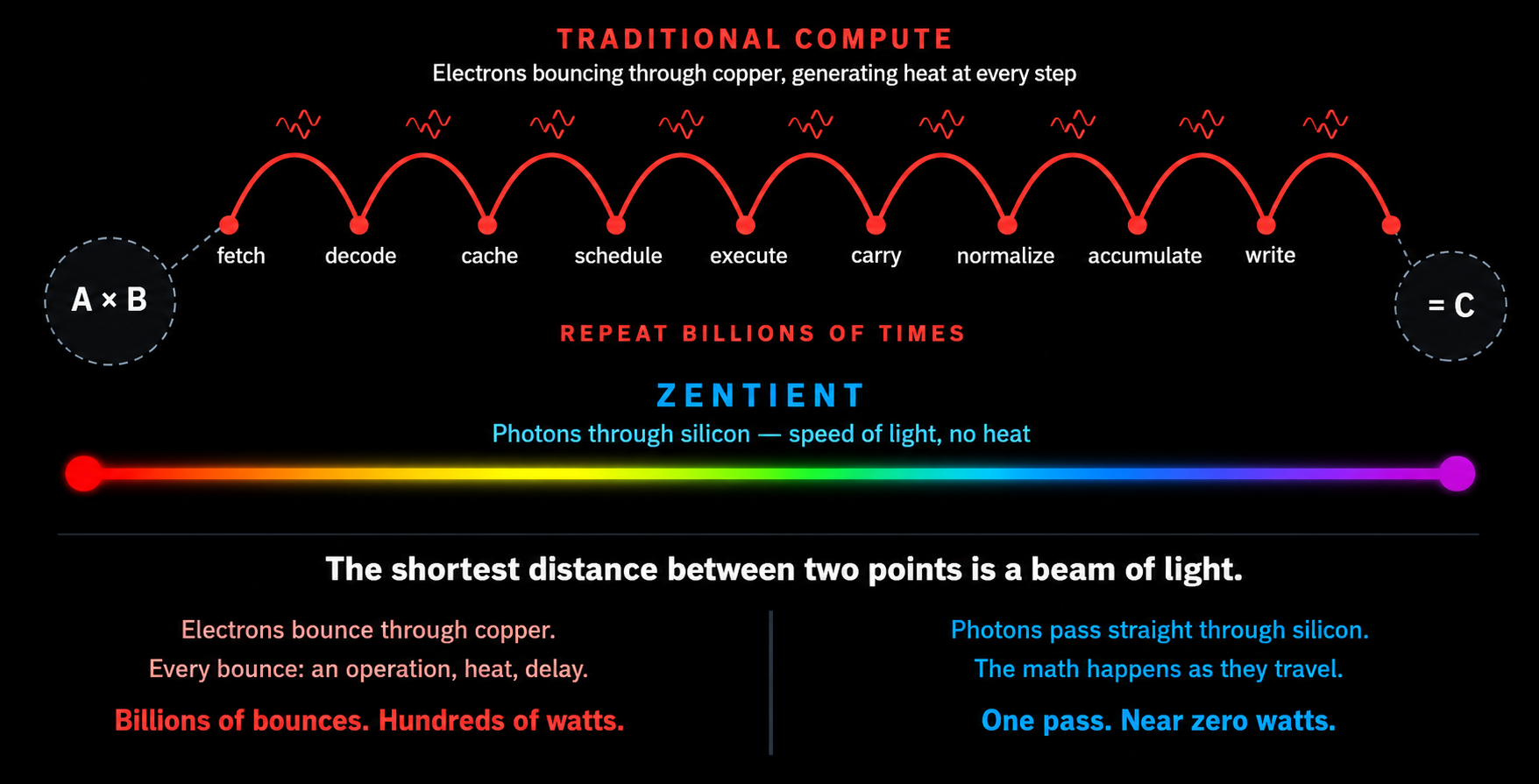
Zentient is developing breakthrough computing architectures that combine neuromorphic principles with photonic processing to pursue a fundamentally different relationship between computation, information movement, energy, and time.
Brain-inspired computing powered by light.
The objective is not simply to make a conventional processor faster. It is to remove constraints that limit what computing can make possible.
What Could Change?
Use Fewer Resources
Reduce the power, cooling, data movement, and infrastructure required to perform demanding computation.
Deliver More
Increase useful computation, responsiveness, density, and economic output within constrained systems.
Make New Things Possible
Enable applications and environments where today's speed, power, heat, infrastructure, or economics create practical limits.
Where Could It Matter?
Zentient is focused on computational problems where a material improvement in architecture can create disproportionate economic, operational, or mission value.
AI & Cloud Infrastructure
Do more useful computation within constrained power, cooling, and physical infrastructure.
Financial Markets
Process information and act where speed, throughput, resilience, and economics directly affect outcomes.
Defense & Space
Bring intelligence closer to the mission where power, weight, thermal constraints, connectivity, and response time matter.
Edge & Industrial
Move intelligence closer to machines, sensors, equipment, and physical processes.
Help Build What Comes Next.
Zentient is building a new computing platform. That requires customers with difficult problems, investors who understand foundational technology, and people who want to solve hard problems.
Some computational problems are not limited by demand. They are limited by the architecture used to solve them.
When speed, power, heat, data movement, infrastructure, or economics materially constrain an important workload, simply adding more conventional compute may not deliver the outcome you need.
Zentient is developing fundamentally different computing architectures for demanding computational problems.
Where a Different Architecture May Matter
We want to talk with organizations where computation creates a meaningful business, technical, or mission constraint.
Examples include workloads where response time materially affects the outcome, where power or heat limits deployment, where data movement creates a performance bottleneck, where infrastructure requirements materially affect economics, where decisions need to happen closer to the data source, or where conventional approaches cannot economically achieve the desired performance level.
Start With Your Situation.
Our first conversation is not intended to force a product into your environment. We want to understand what you are trying to accomplish, what prevents you from doing it today, what matters most, and what a meaningful improvement would be worth.
Have a Compute Problem Worth Solving Differently?
Let's understand it before deciding whether Zentient is the answer.
A New Computing Architecture for a World Demanding More Intelligence.
AI and other demanding workloads are driving extraordinary growth in computational demand. At the same time, power, heat, latency, data movement, physical infrastructure, and economics are becoming increasingly important constraints.
Zentient is pursuing fundamentally better ways to compute.
The world is investing enormous resources in chips, power, cooling, networking, data centers, and infrastructure to satisfy growing demand for intelligence.
A Different Technical Path
Zentient is combining neuromorphic principles and photonic processing to pursue architectures designed around the constraints increasingly shaping computing.
A Platform Opportunity
The same underlying architectural advantage may ultimately matter across multiple high-value computational markets.
A Company Built to Prove It
Zentient is advancing the technology, engaging potential strategic customers and partners, building its team, and raising the capital required to reach the next level of proof.
Market. Proof. Team.
These are the three questions we believe matter most.
Market
Is the problem large enough for a fundamentally different architecture to create significant value?
Proof
Can the technical promise become a useful, manufacturable, deployable system?
Team
Can Zentient build the organization, partnerships, and capabilities required to make it real?
We would rather discuss those questions directly than try to answer them all on a webpage.
Interested in Learning More?
Zentient is currently engaging financial and strategic investors.
Some of Computing's Hardest Problems Are Still Unsolved.
Zentient is building an interdisciplinary team to develop fundamentally better ways to compute.
If you want to work where photonics, neuromorphic computing, semiconductors, systems engineering, software, manufacturing, and real-world applications intersect, we want to meet you.
We are interested in people across:
PhotonicsNeuromorphic ComputingSemiconductor DesignSystems EngineeringSoftware & AlgorithmsPackaging & ManufacturingTesting & ValidationProduct & Program LeadershipSales & Business DevelopmentStrategic PartnershipsOperations
Not every role will be open at the same time. Exceptional people are worth meeting before the job description exists.
Why Zentient?
Because the problem is foundational. Because much of the answer is still being built. Because technical elegance is not enough.
The technology has to work, manufacture, integrate, create value, and scale. Early team members have the opportunity to influence the architecture, products, company, and markets that emerge around it.
Open Positions
First engineering hires shape the architecture, the products, and the company.
Zentient is a photonic neuromorphic computing company commercializing a novel silicon photonic architecture that encodes synaptic weights on a 220nm silicon-on-insulator platform, enabling neural network inference at 2.1 fJ/op with fully on-chip spike-timing-dependent learning. Our GDS v2.0 is tapeout-ready on the AIM Photonics 220nm SOI PDK. Our architecture is protected by 29 patents pending across six clusters spanning the core weight-encoding paradigm, on-chip spectral STDP learning, athermal MRR cladding, latch weight storage, photonic spiking neuron design, and a topology-to-hardware compiler.
The Role
The Technical Lead is the first hands-on engineering hire at Zentient -- the person who takes GDS v2.0 from DRC-clean to first-silicon validation and builds the measurement and characterization infrastructure around it. This is an execution-first role: you will be in the layout tool, at the probe station, and in the AIM Photonics tape-in portal. You will work directly with the CEO and, once hired, the CTO.
The ideal candidate has shipped silicon photonic chips on a commercial PDK, understands MRR device physics at the level required to debug a resonance that isn't where the simulation said it would be, and can write the firmware that calibrates it back.
What You'll Own
GDS & Tapeout Execution
Own GDS layout, DRC/LVS verification, and tape-in submission for ZT-S1 on 220nm SOI. Coordinate tape-in mechanics with Spark Photonics.
Maintain and extend the GDS v2.0 cell library: MRR device cells, heater metal routing, grating coupler I/O, bus waveguide, and wavelength selective switch elements.
Run parametric layout sweeps for MRR radius, coupling gap, and heater geometry to meet the proprietary weight mapping specification.
Device Physics & Characterization
Define and execute the first-silicon measurement program: MRR resonance mapping, heater calibration curve, STDP timing characterization, inter-element thermal crosstalk matrix, and waveguide propagation loss.
Build the wavelength calibration LUT that maps to as-fabricated resonances at startup.
Develop and iterate on the TiO2 athermal cladding process in collaboration with AIM Photonics; characterize the thermal sensitivity coefficient before and after cladding deposition.
Firmware & Control
Write and test thermal PID firmware maintaining the 0.1 pm/C thermal residual target under ambient temperature variation.
Develop STDP coincidence detection readout firmware: pre/post spike timestamp capture, delta-t calculation, and heater current update generation per the STDP kernel.
Maintain and extend the MEMS bistable latch driver firmware: write pulse generation, state verification, and power-gating control.
Simulation & Modeling
Run device-level photonic simulations (Lumerical FDTD/MODE or equivalent) to predict MRR resonance behavior, coupling efficiency, and thermal response before tapeout.
Maintain and extend the system simulation environment: validate STDP learning convergence, benchmark accuracy (N-MNIST, SHD, NARMA-10), and energy-per-operation models.
Build the fabrication variance model: Monte Carlo simulation of resonance offset distribution across a wafer given AIM Photonics process sigma specifications.
Required
Hands-on silicon photonic chip tapeout experience on a commercial PDK (AIM Photonics, GlobalFoundries 45SPCLO, Intel Silicon Photonics, or equivalent)
Proficiency in GDS layout using KLayout, Cadence Virtuoso, or equivalent; working knowledge of DRC/LVS rule decks for silicon photonic processes
Device-level understanding of microring resonator physics: Lorentzian transfer function, free spectral range, coupling coefficient, thermo-optic tuning, and heater design
Experience with photonic circuit simulation tools (Lumerical FDTD/MODE, Meep, or equivalent)
Ability to write firmware for optical hardware control (Python, C, or equivalent) including heater driver firmware, PID loop implementation, and calibration table generation
PhD or MS in Electrical Engineering, Physics, or Applied Physics, or equivalent industry experience with demonstrated tapeout track record
Preferred
Experience specifically with AIM Photonics 220nm SOI process and PDK, including the AIM component library and tape-in submission workflow
Familiarity with TiO2 or other athermal cladding deposition processes and their effect on MRR thermal sensitivity coefficient
Experience with MEMS photonic switches or bistable optomechanical devices
Knowledge of silicon photonic neuromorphic architectures: WDM weight banks, broadcast-and-weight topologies, or MRR-based analog MAC units
Experience setting up and operating a silicon photonics probe station: fiber coupling, swept-source measurement, resonance mapping across a wafer
US citizenship or permanent residency (preferred for federal program participation)
Send your CV and a brief note on your most recent tapeout.
Zentient is a computing platform company pursuing breakthrough architectures for demanding computational problems.
Neuromorphic and photonic technologies are critical to where we are beginning. The problem we exist to solve is larger.
Why We Exist
Purpose
To remove the constraints that limit what computing can make possible.
Vision
A new era of computing where intelligence is no longer constrained by the limits of conventional architectures.
Mission
Develop breakthrough computing architectures that solve the world's most demanding computational problems in fundamentally better ways.
Core Belief
The next generation of computing will not be built simply by adding more compute. It will require fundamentally better ways to compute.
From Scientific Possibility to Useful Technology.
We believe breakthrough ideas matter only when they become reliable, repeatable, manufacturable, and valuable.
That means building with customers, partners, researchers, manufacturers, investors, and people who understand that creating a new computing platform requires both scientific ambition and commercial discipline.
What Role Could You Play?
Customer
Discuss a compute problem that matters to your business or mission.
Start a conversation
Investor
Schedule a meeting or request information about the opportunity.
Learn more
Talent
Explore opportunities to help build fundamentally better computing.
View opportunities
What Would You Like to Discuss?
Choose the topic that best fits, and we will route you to the right conversation.